Viral Insight Hub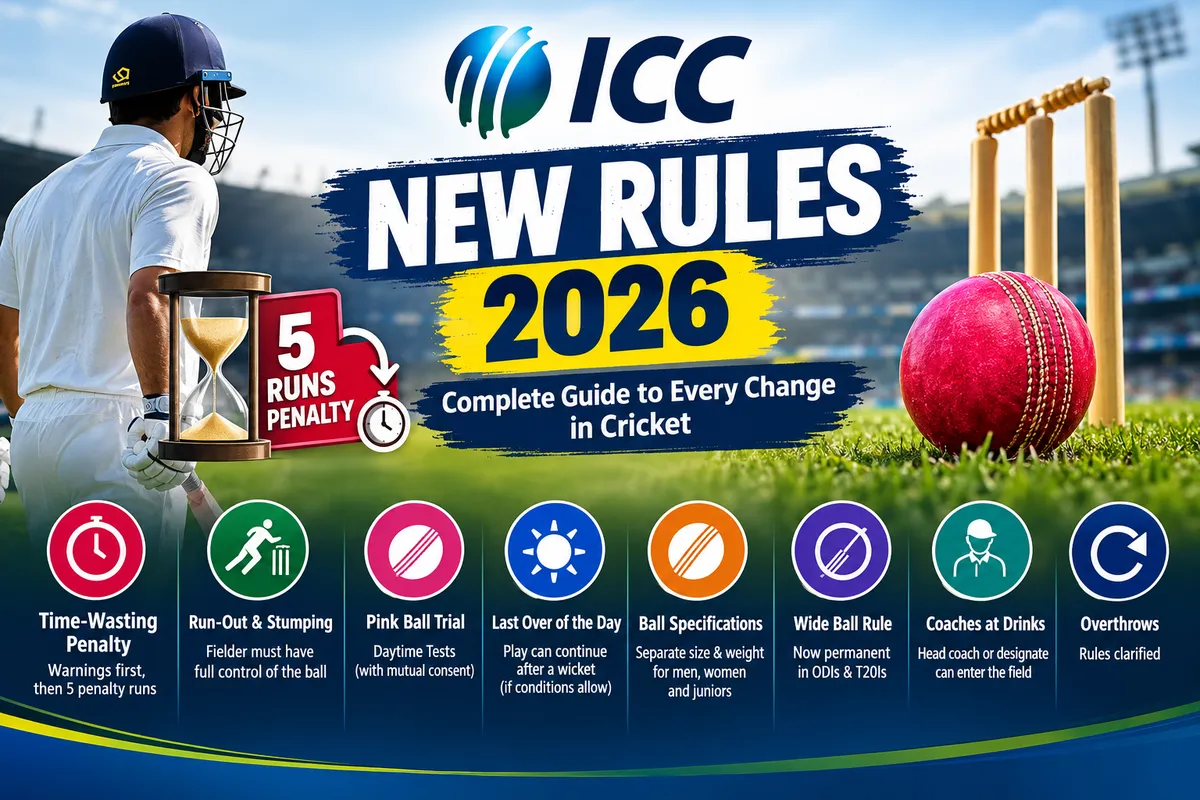
If you watched an international match this week and felt like something was off, you’re probably right. Cricket just got a fresh set of rules. The ICC new rules 2026 touch time-wasting, run-outs, pink balls, ball sizes and more, and a few of them could change how matches are won and lost.
Quick answer: The ICC’s new playing conditions apply to all international series starting on or after 1 October 2026. The headline change is a five-run penalty for batters who keep wasting time, but there are also new rules on fielding clarity, ball specifications, pink-ball Tests and wides.
This guide explains each rule in plain language, so you don’t need to read the rulebook.
What Are the ICC New Rules 2026?
The ICC has updated its Playing Conditions, which are the rules that sit on top of the MCC Laws of Cricket and govern international matches. The changes tackle time-wasting, standardise ball specifications and clarify some aspects of fielding. They also fold in changes to the MCC Laws that took effect on 1 October.
Here’s the part many fans miss: ongoing series continue under the previous regulations, and the new rules only apply to series that begin on or after 1 October. So if a series started in September, you won’t suddenly see the new rules halfway through.
The revised conditions apply to both men’s and women’s cricket across formats.
ICC New Rules 2026 at a Glance
| Rule change | What it means | Applies to |
|---|---|---|
| Time-wasting penalty | Warnings first, then 5 penalty runs | Men’s cricket |
| Run-out and stumping clarity | Fielder must have full control of the ball | All formats |
| Pink ball trial | Teams can agree to use it in daytime Tests | Tests |
| Last over of the day | Play can continue after a wicket if conditions allow | Tests |
| Ball specifications | Separate size and weight rules for men, women and juniors | All formats |
| Wide ball rule | Trial version made permanent | ODIs and T20Is |
| Coaches at drinks | Head coach or designate can enter the field | ODIs and T20Is |
| Overthrows | Rules clarified | All formats |
1. The 5-Run Penalty Rule for Time-Wasting
This is the rule everyone’s talking about, and for good reason.
In men’s cricket, a batter who isn’t ready within the stipulated time gets a warning for the first offence and a final warning for the second. From the third offence onwards, five penalty runs are awarded to the fielding side. Repeated violations can also lead to Code of Conduct charges.
Think of it as a three-strike system. A batter who’s slow to take guard, or who keeps fiddling with kit between balls, now has a real cost attached. To illustrate (this is an example, not an official case), if a team’s batters collect three time-wasting offences during an innings, the opposition simply gets five free runs on the scoreboard.
In a tight T20 or a one-day chase, five runs can easily decide a result. That’s why this change matters far more than it first sounds.
2. Run-Out and Stumping: “Complete Control” Required
Another common source of arguments in the middle gets clearer. The ICC has clarified that for run-outs and stumpings, a fielder must have complete control of the ball.
In practice, that means a fumble, a juggle or a ball slipping out of the gloves while the bails come off is unlikely to count as a clean dismissal. Umpires now have a firmer standard to work with, which should cut down on the replays and debates that follow close calls.
3. Pink Ball Trial in Daytime Test Matches
Test cricket gets an interesting experiment. The ICC will trial the use of the pink ball in day Test matches to reduce the loss of playing time caused by poor light. Under the new provision, both teams can mutually agree to use a pink ball before the match begins.
The idea is straightforward. Pink balls are easier to see in gloomy conditions, so fewer sessions are lost to bad light. It’s a trial, which means the ICC will review how it works before deciding whether it sticks.
4. The Last-Over-of-the-Day Rule in Tests
Here’s a tweak that Test fans will appreciate. Play will no longer automatically end when a wicket falls in the last over of the day if that over hasn’t been completed, provided the weather and conditions are fit for play.
If conditions are suitable, the new batter has to walk out and the remaining balls get bowled. The ICC’s reasoning is that stopping play straight after a wicket doesn’t save time, because the leftover deliveries have to be bowled the next day anyway. The change also keeps the momentum with the fielding side, which is a neat bonus.
5. New Ball Size and Weight Rules, Including Women’s Cricket
Equipment standards got tighter too. The ICC has set three distinct size and weight specifications for men’s, women’s and junior cricket balls. That includes a tighter tolerance on the size and weight of women’s cricket balls.
For players, this means more consistency from one match to the next. For the women’s game in particular, it’s a step towards standards that reflect how the sport is actually played.
6. Wide Ball Rule Now Permanent in ODIs and T20Is
The new wide ball rule was first trialled in the ODI and T20I formats and has now been added permanently to their Playing Conditions. Bowlers and captains who adapted during the trial period won’t need to relearn anything, and everyone else can treat it as the standard from now on.
7. Coaches Allowed on the Field at Drinks Breaks
ODI and T20I conditions are now aligned so the head coach or their designate can enter the field of play during drinks intervals. It formalises something that’s become a regular sight, and it keeps the two white-ball formats consistent with each other.
8. Overthrows Clarified
The ICC has also clarified the rules around overthrows. The reports I’ve seen don’t spell out every detail, so for the exact wording, check the full Playing Conditions on the ICC website.
Why Did the ICC Change These Rules?
The ICC’s own explanation is that the updates are about better balls, clearer fielding rules and a quicker pace of play. Sourav Ganguly, Chair of the ICC Men’s Cricket Committee, said the changes focus on cricket balls, fielding clarity and improving the pace of the game.
My take is that time-wasting is the real driver. Modern white-ball cricket already runs under strict over-rate pressure, and delays between balls add up. A clear penalty ladder gives umpires something to enforce, instead of relying on vague discretion.
How Will the New Cricket Rules Affect Players and Fans?
A few likely effects, and these are my reading rather than official statements:
- Batters will probably be sharper about being ready, especially late in close games where five runs matter.
- Fielding captains may start tracking time-wasting offences as part of their tactics.
- Test fans should see fewer anticlimactic finishes to a day’s play.
- Fielders will need to be cleaner when attempting run-outs and stumpings.
None of this is dramatic on its own, but small rule changes often shape the feel of the game over a season.
What the New ICC Rules Mean for Cricket Going Forward
The ICC new rules 2026 won’t rewrite cricket overnight, but they tighten the screws on time-wasting, give umpires clearer fielding standards, and test a sensible pink-ball idea for Tests. Keep an eye on how the five-run penalty is used in the first few series, because that’s where the real impact will show.
Want more simple, no-fluff cricket explainers like this one? Keep following Viral Insight Hub, and share this guide with your cricket group so everyone’s on the same page.
FAQs About the ICC New Rules 2026
When do the ICC new rules 2026 come into effect?
They apply to all international series that start on or after 1 October 2026. Series already in progress follow the old rules.
What is the 5-run penalty rule in cricket?
A batter who isn’t ready within the allowed time gets a warning, then a final warning. From the third offence, the fielding side is awarded five penalty runs.
Does the time-wasting penalty apply to women’s cricket?
The reports describe the time-wasting penalty as a men’s cricket provision, so check the official ICC Playing Conditions for the women’s game.
What is the pink ball trial in Test cricket?
Teams can mutually agree before a match to use a pink ball in daytime Tests, to reduce time lost to poor light.
What has changed for run-outs and stumpings?
The fielder must have complete control of the ball for the dismissal to count.
Is the new wide ball rule permanent?
Yes, for ODIs and T20Is. It was trialled first and is now part of the permanent Playing Conditions.